Simplifying fixed orthodontics by treating the causes
In Orthodontics, the understanding of the link between function as well as facial growth and development has progressively improved.
For the published PDF version click here
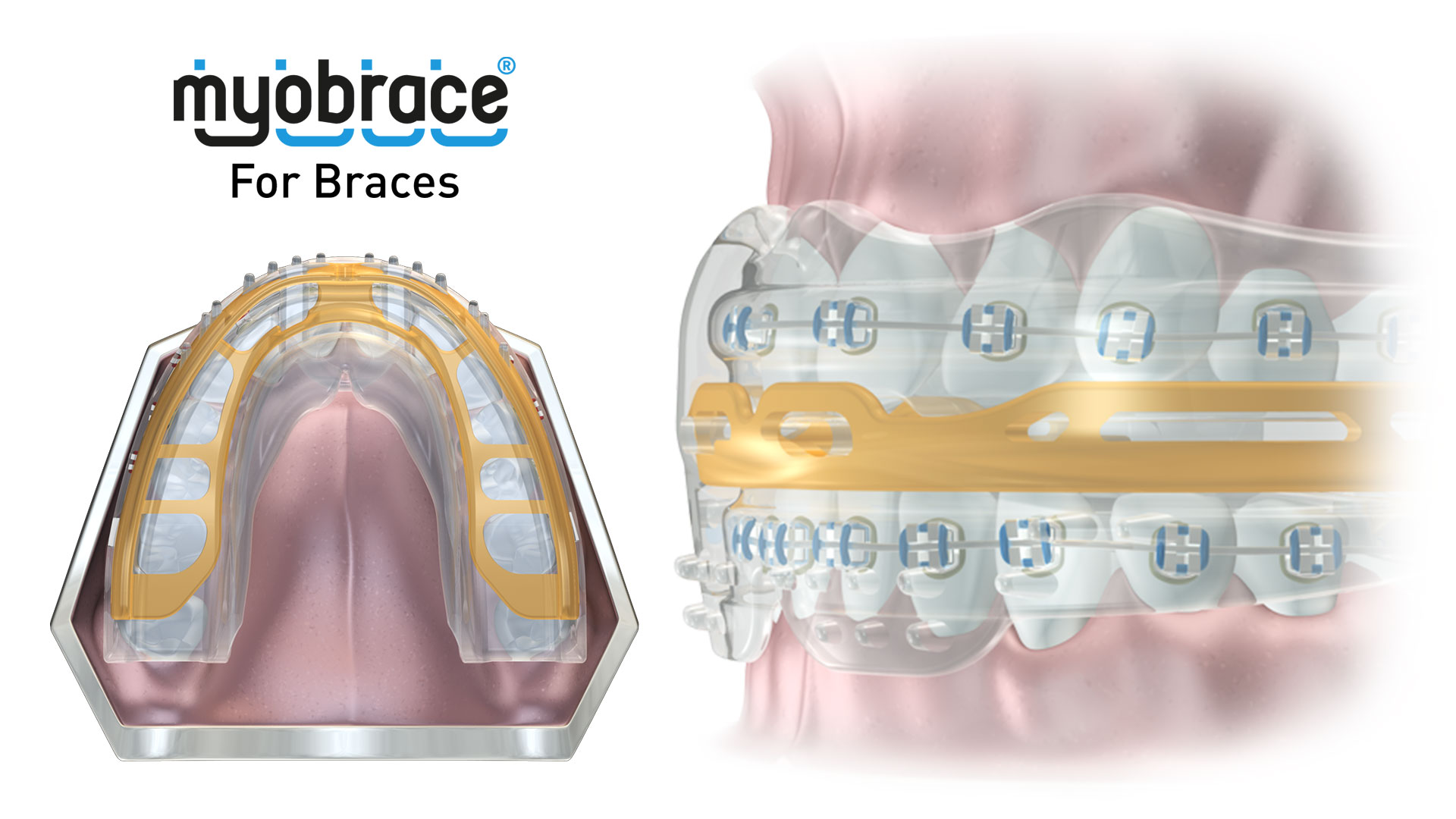
The Myobrace for Braces series is used in combination with fixed orthodontics.
The power of incorrect muscle pressure on the position of the teeth and jaw has been recognised for more than 50 years.[1] Now, we also know that children with sleep-related breathing problems will often develop distinctive facial characteristics.[2] In adults, sleep apnoea can result in serious morbidity and mortality.[3] Muscle dysfunction can affect the patient’s overall health so treatment of the dysfunction should not be dismissed in orthodontic diagnosis and treatment planning.
In September 2018, the World Dental Federation (FDI) publicly highlighted the important role of dentists in prevention, early screening and treatment of Sleep-Related Breathing Disorders (SRBD). Treating these patients can lend itself to collaboration with other medical specialties to improve a patient’s health and treatment outcome.
RELATED: 'A resolution to the limitations of orthodontics' by Dr Jessica Waller
Myofunctional Research Company’s (MRC) highly developed treatment system for breathing, myofunctional and orthodontic correction provide dental professionals and orthodontists with the ability to approach the functional side of orthodontics more readily. This is achieved by having an easily accessible and useable appliance system which first directs treatment at establishing correct breathing and oral muscle habits.
By the time most orthodontic patients have presented for braces treatment, a great deal of the damage from muscle dysfunction has already occurred, such as “adenoidal facies” (aka “long face syndrome”) in particular from mouth breathing and subsequent low tongue posture. Most practitioners agree treating the dysfunction as young as possible has the greatest effects to improve craniofacial development, however treating the dysfunction later, or in older patients, still has its merit and can still decrease treatment time, allow better arch expansion and better stability of orthodontic treatment, not to mention the overall health benefits to the patient.
Orthodontic treatment can be particularly challenging in patients with severe muscle dysfunction. The incorrect muscle pressure on the orthodontic brackets, wires and teeth can impede the correct orthodontic movement desired by the treating practitioner. By including a myofunctional appliance in conjunction with traditional orthodontic treatment, challenging cases can be converted to more easily treated cases.[4] Combining braces with the Myobrace®B-range allows simple management of function to allow the fixed braces to move to their best ability without hinderance.
CASE STUDY: FEMALE, 12 YEARS OLD
The patient's main concern was to improve the alignment and occlusion; however, the parents did not want any extractions or interproximal reduction (IPR). The patient was treated with upper braces along with the Myobrace B2, as there was not enough positive overjet to fit the lower braces without performing any IPR.
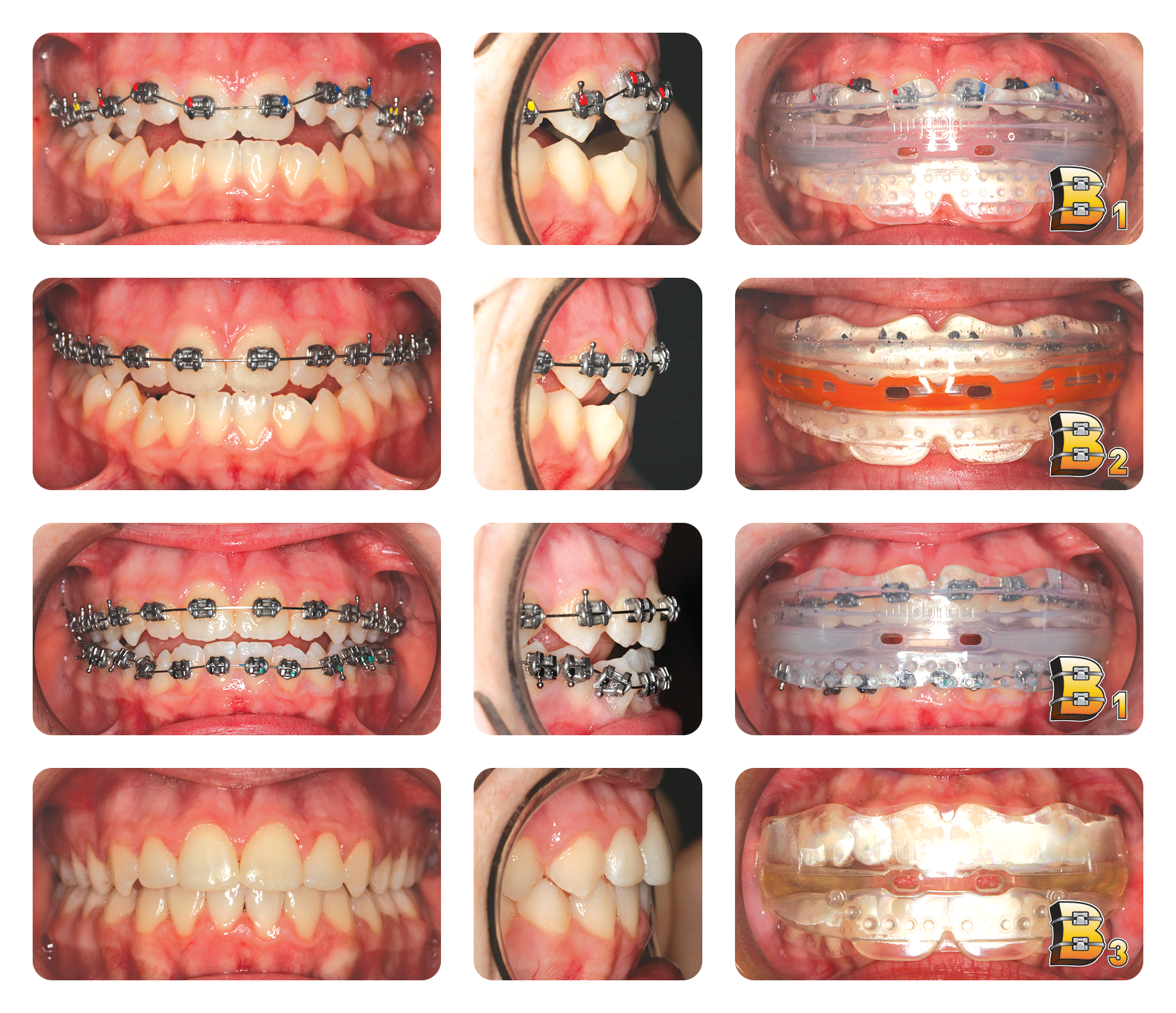
First row: Start of treatment; Second row: Three months intro treatment; Third row: Seven months into treatment; Fourth row: Completion of treatment after 15 months.
Once sufficient positive overjey was created, the lower braces were fitted. Patient only required 15 months of treatment in total, creating a positive overbit and overjet, finishing in removable thermoformed retainers and the Myobrace B3.
The Myobrace for Braces (B-series) includes three appliances. The B- Stage 1 (B-1) can be used prior to fitting braces or at the initial fit and starts to establish correct nasal breathing and tongue posture. The B1 allows sagittal correction to begin straight away, prevents initial soft tissue irritation by covering the brackets and wires, while separating the arches allowing better development through disocclusion. The B1 is used while levelling and aligning is taking place.
The B- Stage 2 (B-2) is the next appliance in the series. The B2 is a firmer appliance which continues to work further on arch expansion by improving the swallowing method through restricting the use of the buccinators and mentalis muscles, allowing only the tongue to function in swallowing, creating outward expansion pressure with no inward restriction from the cheeks and lips. The B-Stage 3 (B-3) is the retention appliance to be used once the braces have been removed and the patient is in removable vacuum-formed retainers. The retainers are used to maintain the dental alignment until the alveolar bone has remodelled, in around 3-6 months.
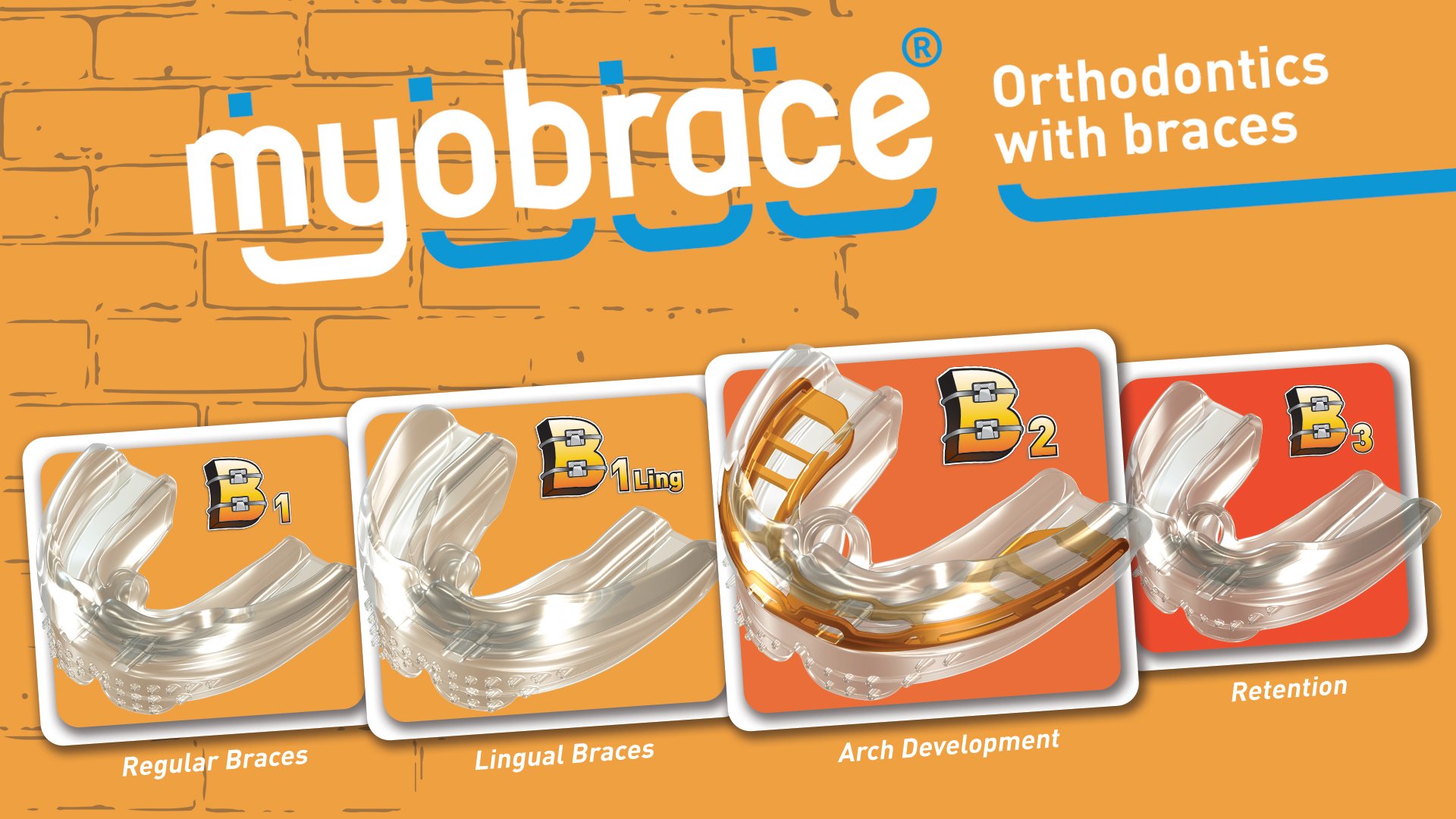
The B3 works over the top of the retainers to maintain the sagittal correction which has taken place throughout treatment until neuromuscular adaptation has taken place. Muscle adaptation is the part of orthodontic treatment which takes the longest to modify, around 12-24 months,5,6 which is why a retention appliance holding the sagittal correction is essential following any orthodontic treatment. All of these appliances are worn for 1-2 hours while awake and overnight while asleep, in conjunction with conventional orthodontic treatment.
The Myobrace B-range truly helps to simplify conventional orthodontic treatment, is readily available to order without incurring expensive lab fees or waiting for referrals to auxiliary health professionals and provides multiple benefits to the patient and practitioner.
Interested in learning how to use MRC's appliances?
Our FREE introductory course is the perfect starting point for any healthcare practitioner wanting to learn how to use our treatment systems.